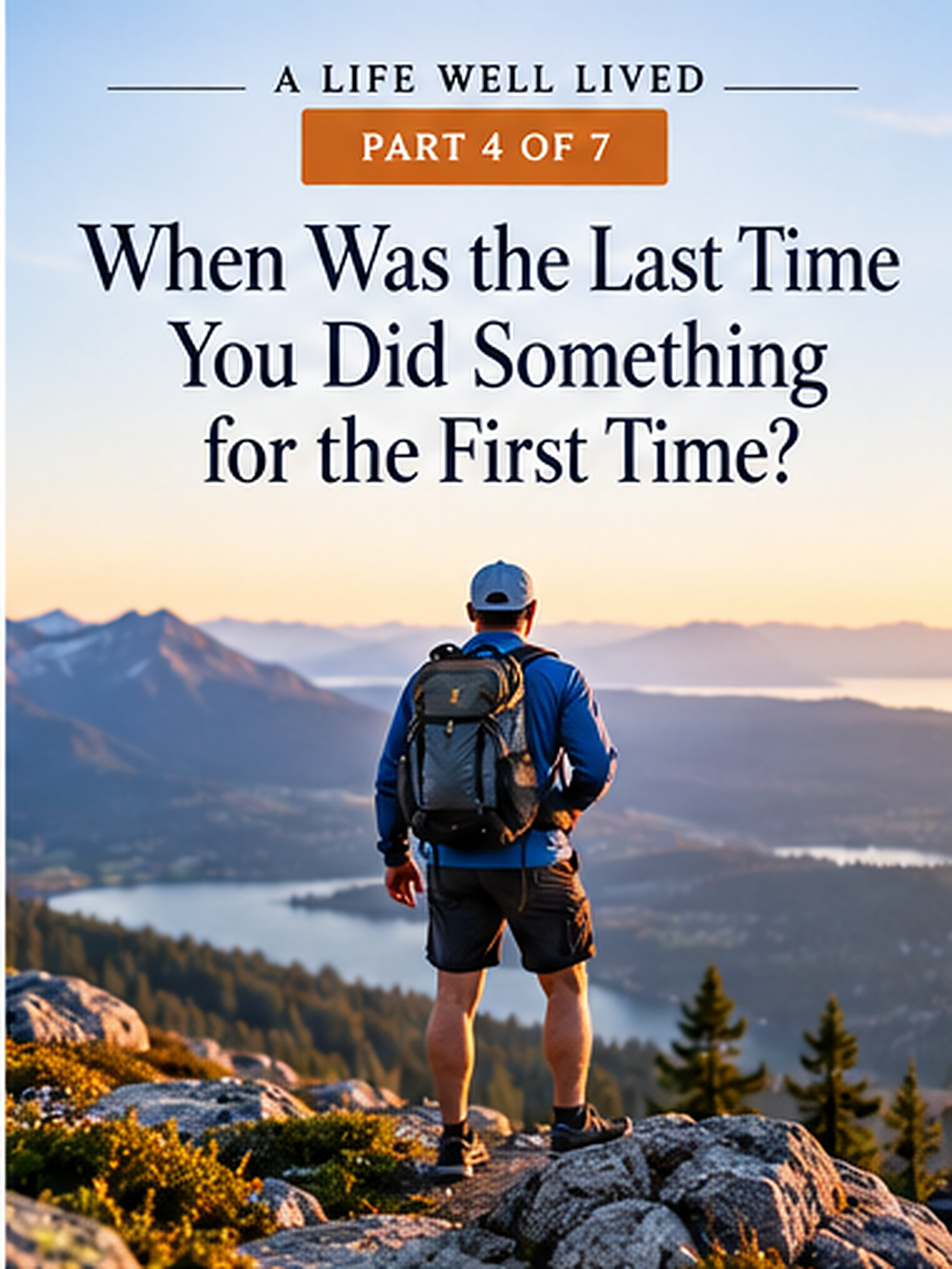
By Mark & Daniela | A Life Well Lived — Part Four
Remember learning to ride a bicycle?
The uncertainty of those first few attempts, the scraped knees, the wobbly handlebars, and then that wonderful moment when everything finally came together?
As children, we spend much of our time being beginners.
Almost everything is new. We fall, get back up, try again, and celebrate the smallest accomplishments.
But somewhere along the journey into adulthood, many of us become less enthusiastic about being inexperienced.
We’ve worked hard to become competent in our careers, our hobbies, and our everyday lives.
We’re comfortable knowing what we’re doing.
And there’s certainly something satisfying about that.
But perhaps there’s also something we’re missing.
When was the last time you tried something you weren’t already good at?
The Comfort of the Familiar
As adults, our lives can gradually become a collection of familiar routines.
We eat at our favorite restaurants, follow the same walking routes, spend time with the same friends, and gravitate toward activities we know we’ll enjoy.
There’s nothing wrong with that. Familiarity can be comforting.
But comfort and growth don’t always travel together.
Sometimes, the only way to discover a new passion is to risk being a little awkward or unsuccessful at first.
Imagine someone who has always wanted to learn to play an instrument but thinks they’re too old.
Or someone who’s interested in hiking, painting, dancing, or learning another language but worries they’ll look foolish.
We’d encourage them to ask themselves a simple question:
So what if I’m not very good at it?
Isn’t that how every accomplished person began?
There’s Joy in Being a Beginner
One of the great freedoms of adulthood is that we no longer need to prove ourselves at everything we try.
We can do something simply because we enjoy it.
We can take a class without becoming an expert.
We can participate in a sport without winning.
We can learn to cook something new and laugh when the result looks nothing like the picture.
And sometimes, what begins as an awkward experiment becomes an important part of our lives.
Even when it doesn’t, we come away with a story, a little knowledge, and perhaps a greater willingness to try again.
Recently I started skateboarding in parks again…believe me, this is very humbling.
My mind and body are not in sync, in other words, what I imagine doing, isn’t close to what I can do.
So this is not something new, I used to be decent, long ago.
It is a rekindling of something I have really enjoyed in the past, and guess what…
There are a lot of other people trying to do the same thing so there is camaraderie, and it is still really fun…the smallest improvement feels great!
Growth Doesn’t Have an Expiration Date
It’s easy to convince ourselves that certain opportunities have passed us by.
Maybe we’re not as athletic as we once were. Maybe learning takes a little longer. Maybe we have limitations that weren’t there twenty years ago.
Those realities deserve respect, but they don’t have to define everything that’s possible.
We can adjust our expectations, choose activities suited to our abilities, and still enjoy the excitement of discovering something new.
In fact, doing something unfamiliar can remind us that we’re capable of more than our routines might suggest.
A Thought to Take With You
Here’s our invitation for the coming month.
Do something you’ve never done before.
Try a new recipe. Visit a place you’ve never explored. Take a lesson. Start a conversation with someone outside your usual circle.
It doesn’t matter whether you turn out to be particularly good at it.
The purpose isn’t to impress anyone.
It’s to remain curious, engaged, and open to life’s possibilities.
After all, we don’t stop having adventures simply because we grow older.
Sometimes we grow older because we’ve stopped looking for adventures.
— Mark & Daniela
Next in our series: The Quiet Power of Giving People the Benefit of the Doubt.